
Picking a solar system size is the decision that shapes your savings for the next two decades. Too small and you leave value on the table; too large and you export power cheaply.
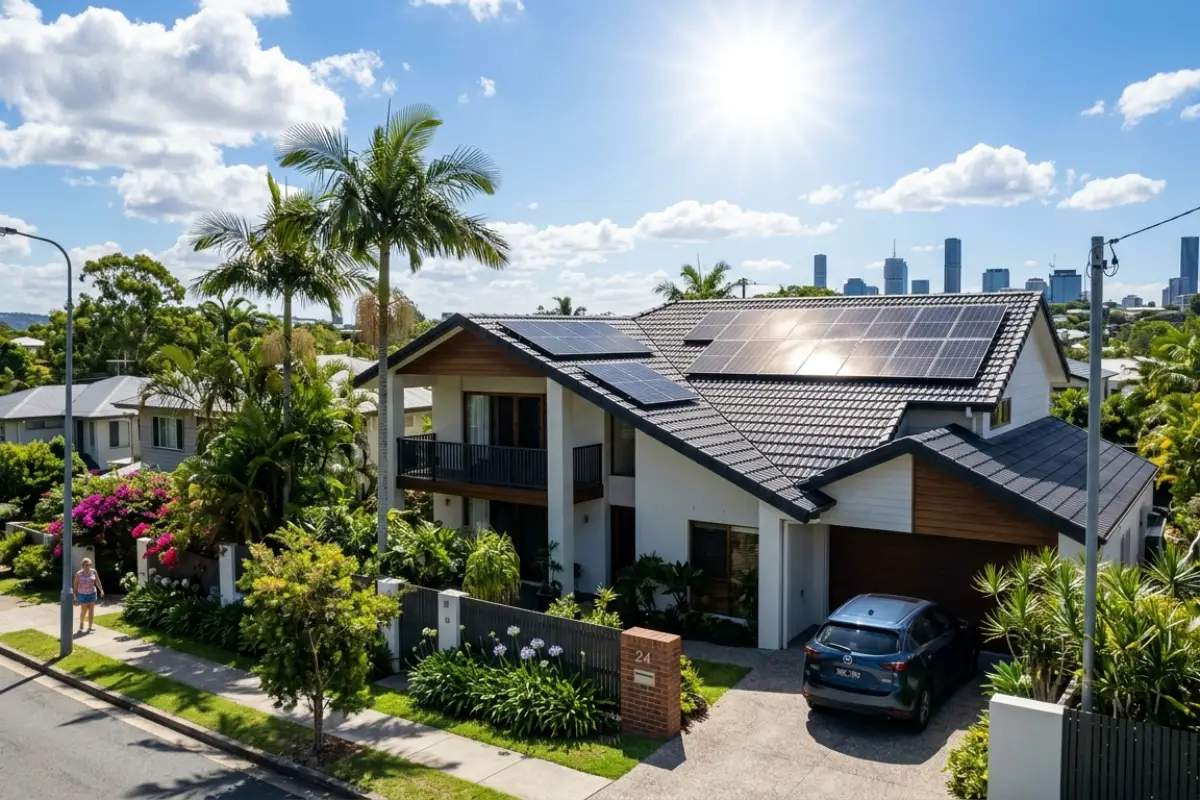
Brisbane’s strong sun makes solar a smart investment, but the right size depends on your home, not a one-size-fits-all number. The key is matching the system to how much power you actually use.
This guide shows you how to work out your ideal size from your own electricity bill, how household type affects the answer, and the local factors that change the maths.
Table of Contents
- Start with your electricity usage
- A simple way to estimate your size
- Why 6.6kW is so popular
- Matching size to your household
- Local factors that change the size
- Sizing mistakes to avoid
- Do not forget the inverter
- Common questions
Start with your electricity usage
The right system size flows from one number: your average daily electricity use in kilowatt-hours, which you will find on your power bill as the total usage divided by the days in the billing period.
Australian homes commonly use somewhere in the range of 11 to 23 kWh per day, with families and all-electric homes at the higher end. Knowing your figure turns sizing from guesswork into a calculation.
Once you know your daily usage, you size the system to cover the share of that power you use during daylight, when the panels are generating.
A simple way to estimate your size
You can get a solid first estimate from two numbers on your bill and one local figure. It turns a sales pitch into a calculation you control.
In Brisbane, each kilowatt of well-oriented panels generates roughly four to five kilowatt-hours on an average day across the year. So a 6.6 kW system produces somewhere around 26 to 33 kWh per day on average, with more in summer and less in winter.
Take your average daily usage, then estimate how much of it falls in daylight hours. If you use 20 kWh a day and around half of that is during the day, you want a system that comfortably covers that daytime load with some export to spare.
Match the system’s daily output to your daytime consumption first, then add a margin for future use. Sizing purely to total daily usage overstates what you need if most of your power is used after dark.
Why 6.6kW is so popular
The 6.6 kW system has become the default choice for average Australian homes, and there are good reasons for it.
Solar has become mainstream nationally. According to the Australian Renewable Energy Agency, more than 30 per cent of Australian households now have rooftop solar PV, and that scale has driven down installation costs and made mid-sized systems excellent value.
In Brisbane’s strong sun, a 6.6 kW system generates plenty for a typical family on a clear day. It hits a sweet spot between upfront cost and daily output, which is why so many homes land on it.
Matching size to your household
Your household’s usage pattern is the real driver of the right size. Use this as a starting guide, then refine with your actual bill.
| Household | Typical daily use | Common system size |
| Couple or small home, low daytime use | Lower | Around 5 to 6.6 kW |
| Family, someone home during the day | Moderate to high | Around 6.6 to 10 kW |
| Large or all-electric home, pool or EV | High | 10 kW and above |
The more power you use during daylight, the larger a system you can justify, because you consume that generation directly rather than exporting it cheaply.
Local factors that change the size
Two Brisbane homes with the same bill can still need different systems. These factors explain why.
Roof space and orientation
Each kilowatt of panels needs roughly five square metres of roof. North-facing roofs generate the most over a day, so available space and orientation can cap or boost your ideal size.
Future usage
If you plan to add an electric vehicle, a pool, or move to all-electric appliances, sizing slightly larger now avoids a costly upgrade later.
Shading
Trees, neighbouring buildings, and chimneys reduce output. Heavy shading may mean a larger system or a different panel layout to hit your target generation. A specialist such as Solar Power Systems Brisbane.com can assess your roof, shading, and usage to size the system precisely, which is where most of the long-term return is won or lost.
Sizing mistakes to avoid
A few common errors cost homeowners real money over the life of a system.
Undersizing to save on the upfront price often means buying expensive grid power you could have generated. Oversizing without high daytime use means exporting at low feed-in rates. Ignoring future EV or pool plans leads to an early, costly upgrade.
Sizing from a guess rather than your actual bill is the root of most of these mistakes.
Another quiet mistake is ignoring export limits. Some networks cap how much you can send back to the grid, so an oversized system may have its export curtailed, which wastes the generation you cannot use yourself.
Do not forget the inverter
System size is usually described by panel capacity, but the inverter quietly shapes your real-world output and your options later.
Inverters are often sized a little smaller than the panel array, a setup known as oversizing the array. A 6.6 kW panel array paired with a 5 kW inverter is common and perfectly sensible, because panels rarely hit their full rating and the inverter captures most of the generation.
If a battery or extra panels are on your horizon, mention it when sizing. A hybrid inverter or one with headroom now can save a costly replacement when you expand the system later.
Match the inverter quality to the panels, too. A cheap inverter on good panels is a common weak link, since the inverter is the component most likely to need replacing within the system’s life.
Conclusion
The right solar system size in Brisbane comes from your actual daily usage, your roof and shading, and your future plans, not a single recommended number. Start with your bill, match the size to how much power you use in daylight, and you will land on a system that pays back fast and keeps saving for decades.
Planning other upgrades, too? Read our related guide on other home improvement projects worth budgeting for.
Common questions
How many panels are in a 6.6kW system?
Roughly 16 to 18 panels, depending on each panel’s wattage, taking up around 30 square metres of roof.
Should I size for now or for the future?
If you expect to add an EV, pool, or electric heating, sizing a little larger now is usually cheaper than upgrading later, provided you have the roof space.
Does a bigger system always save more?
Only if you use or store the extra power. Beyond your usage, surplus is exported at low feed-in rates, so match the size to consumption rather than maximising panels.
How much roof space does a 6.6kW system need?
Around 30 square metres of relatively unshaded roof, since each kilowatt needs roughly five square metres. North-facing pitch is ideal, though east and west splits still work well for homes that use power across the day.
What if my roof cannot fit the size I need?
You can use higher-wattage panels to fit more capacity into less space, split panels across multiple roof faces, or prioritise the best-oriented sections. A site assessment works out the best layout for a constrained roof.
Will a larger system shorten my payback?
Not on its own. Payback shortens when you actually use the generation, so a larger system only pays back faster if your daytime usage rises to match it, for example, after adding an EV or pool.